Taxi website development
Nobody searches for a taxi company. They search for a route and a price: “Gaggal airport to Dharamshala taxi fare”, “Pathankot to Kangra cab”, “taxi service in Palampur”. A taxi website wins by answering each of those on its own page, with the fare written down, and ending in WhatsApp. I've built taxi websites for five operators in the Kangra valley, most of them owner-drivers up against commission agents and call centres.
What a taxi website has to do
A page for every route you drive
Each route gets its own URL with the road distance, the car and the fare, because that's what people type. Kangra Valley Travels has 49 taxi route pages; Baglamukhi Travels has 67.
The all-in fare, written down
Car, driver, fuel and tolls in one figure, as text on the page, not “call for quote”. Nandini Travels publishes an all-in fare on 15 of its 18 route pages, and the long hauls say “Fare on WhatsApp” until the operator settles them.
Airport and station pickups
Kangra Airport at Gaggal, Pathankot and the railway stations get pages of their own, because flyers search before they land. Shiva Tour and Travel runs from beside the airport.
Town pages for “taxi service in ”
Local taxi searches are town by town. Sunny Himachal Travels has nine town pages, each written from what the business is actually booked for in that town.
One fares file
Fares are written once and fill the route cards, the FAQs, the structured data and llms.txt, so the page and Google can never show different prices. On Sunny's site, a build test fails if they ever disagree.
Only facts the driver gave
No fleet that doesn't exist, no ratings nobody gave, no “only 2 cars left” badges. Shiva's build bans fake stats and reviews outright, and Kangra Valley Travels' build fails on any claim the driver hasn't confirmed.
Selling tour packages, treks and multi-day trips more than transfers? Travel & tour operator websites
What five taxi sites taught me
The number is what ranks
Baglamukhi Travels launched with ten pages and 27 point-to-point routes, each with an all-in fare on the page, because people type “gaggal airport to dharamshala taxi fare” and a page that says “call for quote” has no number to match. It has since grown to 67 taxi-route pages and 139 in all, and drew 41,829 Google impressions and 246 clicks in the 28 days to 3 November 2026 (client's Search Console). Read the case study →
Distance pages and fare pages do different jobs
At least 13,100 of those impressions came from searches like “chandigarh to baglamukhi distance”, which Google answers on the results page, so few people click. Searches with taxi intent were about 650. Distance pages earn visibility; route-and-fare pages earn bookings, so the fare pages get the attention.
Fold the routes you don't really drive
After Google's September 2026 spam update, Sunny Himachal Travels folded six routes that never touch the Kangra valley, such as Delhi to Manali, into plain lines on one taxi page with 301 redirects, and kept pages only for the eight that end in or near the valley. Read the case study →
Road distances from map data
Kangra Valley Travels gives one road distance per route, measured from map data. Drive times vary with the season and the traffic, so the distance is the fact and the time is an estimate. Read the case study →
Built and live

Baglamukhi Travels
Owner-drivers competing against commission agents for Kangra's airport transfers and the Devi Darshan yatra — now 41.8K Google impressions and 246 clicks in 28 days.
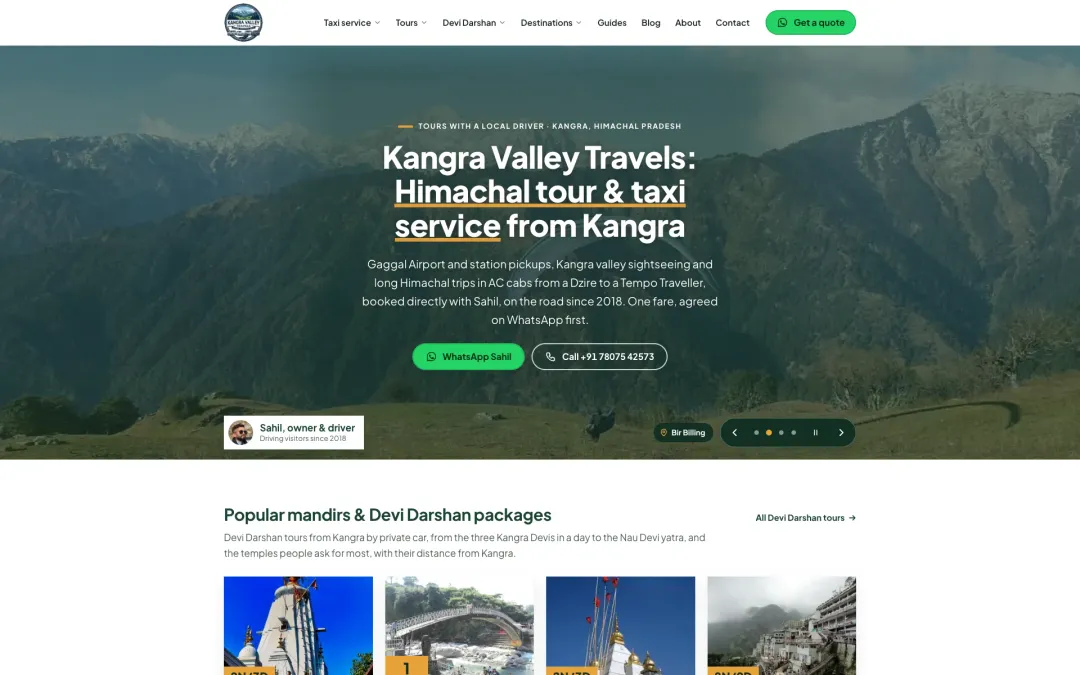
Kangra Valley Travels
An owner-driver who started with one Ertiga, now 158 pages in his site's sitemap — and a build that refuses any fare, rating or claim the driver hasn't confirmed.
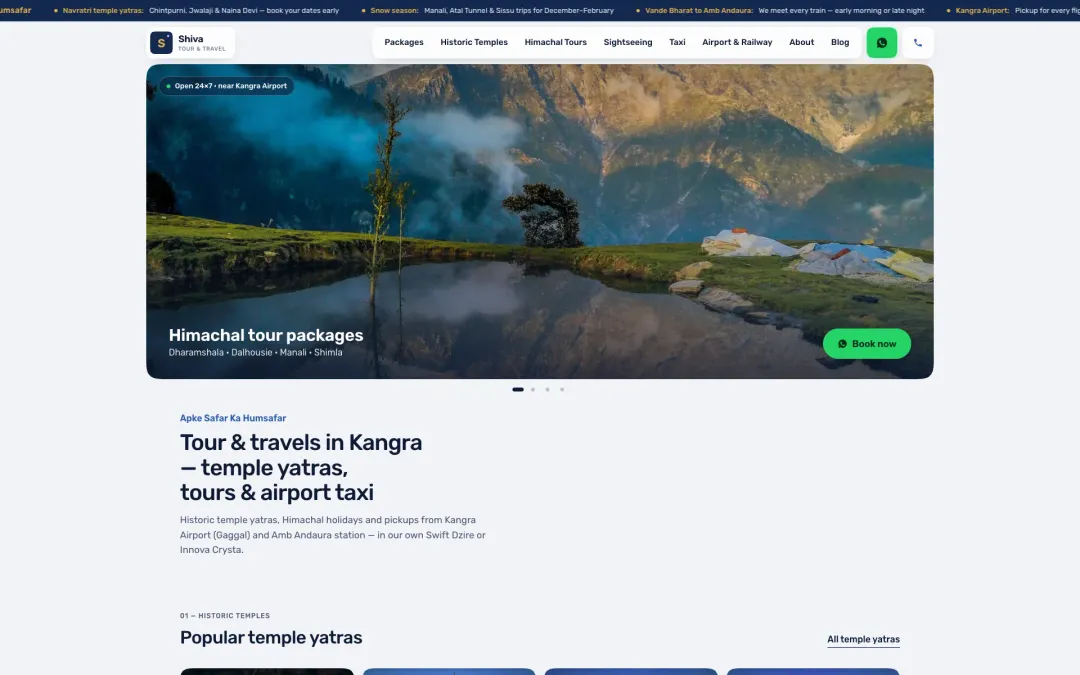
Shiva Tour and Travel
A taxi and temple-yatra operator beside Kangra Airport, rebuilt from a mockup that invented its own reviews — and a build that stops them coming back.

Sunny Himachal Travels
A page for every trip, transfer and town in the Kangra valley — 1.1 KB of its own JavaScript, Lighthouse 100 on all four desktop scores.
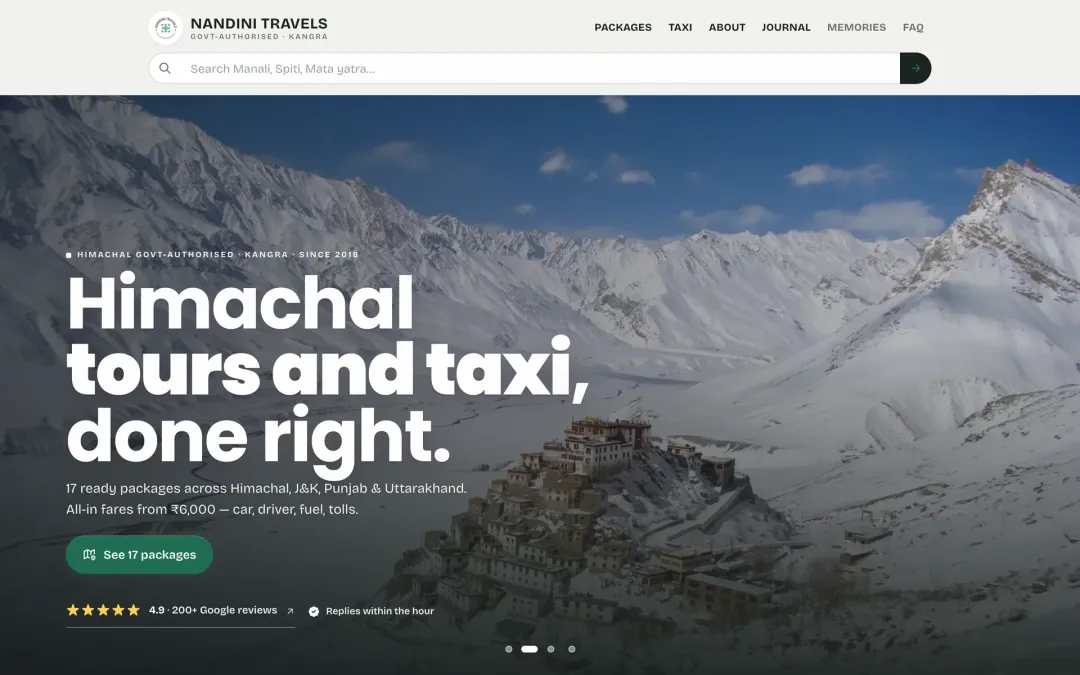
Nandini Travels
A Kangra taxi operator strong on Google Maps stopped losing every lead to it.
How the build runs
- FP101
One call
The routes you actually drive, the cars, the fares you'll commit to, and where bookings come from today.
- FP202
A route map
One page per route people search for, checked against your Google Business Profile and Search Console data where you have any.
- QUALI03
Design and build
Route, town and airport pages from one fares file, WhatsApp on every screen, and local business schema.
- RACE04
Grow it
New routes added when you start driving them, and routes that bring nothing folded rather than left thin.
Questions I get.
One for each route people book, the airport and station pickups, one for each town people search “taxi service in” for, the cars, the FAQ and a contact page. The homepage can't rank for all of those searches by itself.
Yes. Publish an all-in fare for the common routes and keep it in one fares file, so a change is one edit that updates every page, the FAQs and the structured data together. A route whose fare you can't commit to can say “Fare on WhatsApp” instead of a guess.
Usually not. Most taxi trips in Himachal are confirmed on WhatsApp and paid to the driver, so a form that writes the trip into a WhatsApp message converts better than a payment page. An advance can be taken by UPI where you need one.
From ₹15,000. The final number depends on how many routes, towns and pickups need their own pages; I quote fixed and in writing after one call, and you own the code.
It gives you a channel you own. Baglamukhi Travels' owners had been on the road since 2018 with no channel they controlled; their site drew 41.8K Google impressions in the 28 days to 3 November 2026, and a traveller who finds it books them directly, not through an agent.
A route is one entry in the fares file plus a few lines about the road, so it can be added without touching the design. If you'd rather not edit anything, send the route and fare on WhatsApp.
Tell me about yours.
Message me what you run and where. I'll tell you honestly what a website would change, and what it would cost, fixed and in writing.