Travel & taxi website development
Travellers don't search for “travel agency”. They search for a route, a trip or a town: “Delhi to Dharamshala taxi”, “Spiti tour package”, “taxi service in Palampur”. A travel site wins by having an honest page for each of those searches, with WhatsApp at the end of it. I've built travel sites for four operators in Kangra and Dharamshala.
What a travel website has to do
A page for every route and trip
Each transfer and tour gets its own URL, with the distance, the road and what's included, because that's the level at which people search.
Town pages for “taxi service in ”
Local taxi searches are town by town. Sunny Himachal Travels has nine of these pages, each written from what the business is actually booked for in that town.
Prices before anyone has to ask
Where the operator can commit to them, published all-in fares for the common routes. Baglamukhi Travels lists 27 point-to-point routes this way.
WhatsApp at the end of every page
The message arrives pre-filled with the trip, and a sticky bar keeps WhatsApp and Call one tap away on a phone. That's where these bookings close anyway.
Local business schema that holds up
Geo-coordinates, opening hours, services and ratings in structured data, with the same name, address and phone as the Google Business Profile.
No thin pages
Growing to a hundred pages is exactly where travel sites go thin. Sunny's build fails if any two pages read too alike, so pages that would overlap are dropped rather than published.
Built and live

Sunny Himachal Travels
A page for every trip, transfer and town — 1.1 KB of JavaScript and Lighthouse 100 on all four desktop scores.

Baglamukhi Travels
Owner-drivers competing against commission agents for Kangra's airport transfers and the Devi Darshan yatra — now averaging position 5.7 on Google.
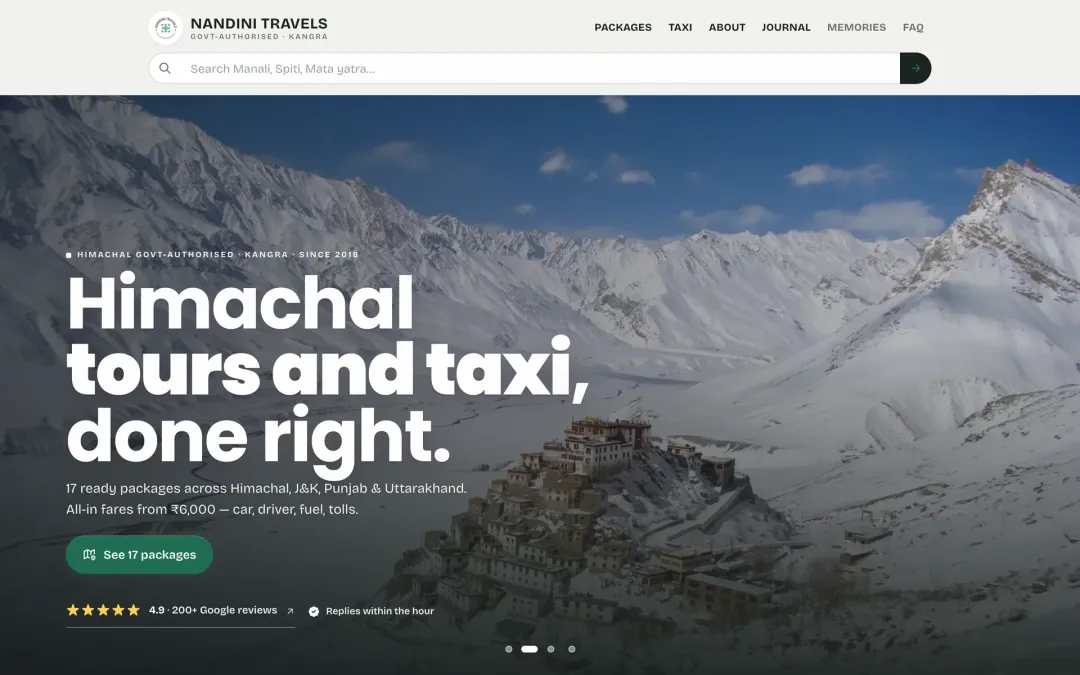
Nandini Travels
Kangra's most positively reviewed taxi operator stopped losing every lead to Google Maps.
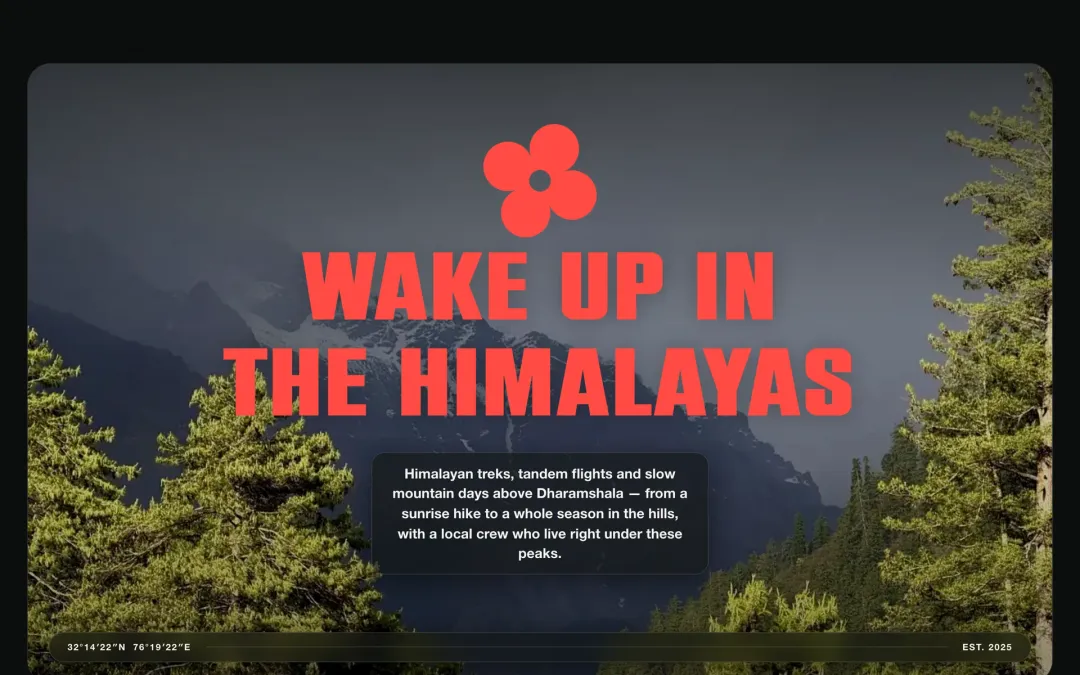
Dharamshala Tours
A WhatsApp-first booking flow, part of roughly 1,000 travel packages booked every month.
How the build runs
- FP101
One call
The routes, trips and towns that actually make money, and how bookings arrive today.
- FP202
A page map
One page per real search, checked against Search Console and Maps data where the business has any.
- QUALI03
Design and build
Fast static pages, WhatsApp on every screen, local business schema and an llms.txt for AI assistants.
- RACE04
Grow it
New routes and seasonal trips added as demand shows up, without duplicating what's already there.
Questions I get.
One for each route people book, one for each trip or package, one for each town people search “taxi service in” for, plus the fleet, the FAQ and a contact page. The homepage can't rank for all of those searches by itself.
Usually not in Himachal. Most trips are confirmed on WhatsApp and paid at or after the trip, and a payment gateway adds friction for no gain. It can be added where advance booking genuinely needs a deposit.
Expect weeks to months, depending on competition and on the Google Business Profile. Baglamukhi Travels now averages position 5.7 on Google against aggregators and call centres.
From ₹15,000. The final number depends on how many routes, trips and towns need their own pages; I quote fixed and in writing after one call, and the operator owns the code.
Yes. Dharamshala Tours' team publishes seasonal itineraries themselves, and Sunny Himachal Travels' trips and routes are plain content files that can be added without touching the design.
No. The four travel sites so far are in Kangra and Dharamshala, but the same approach works for any operator in India whose customers search by route and town.
Further reading
Tell me about yours.
Message me what you run and where. I'll tell you honestly what a website would change, and what it would cost, fixed and in writing.